


Match the Model to the Moment: Fractional, Consultant, or Executive Search
By Jamie Jacobs
Most HR leadership problems come down to one of three things: you need someone to diagnose what's broken and tell you what to fix, you need to hire a permanent HR executive, or you need experienced HR leadership running the function right now. Each one maps to a different solution. And choosing the wrong one isn't just expensive — it costs you months you don't have and sometimes much more.
What Each One Actually Does
The HR Consultant
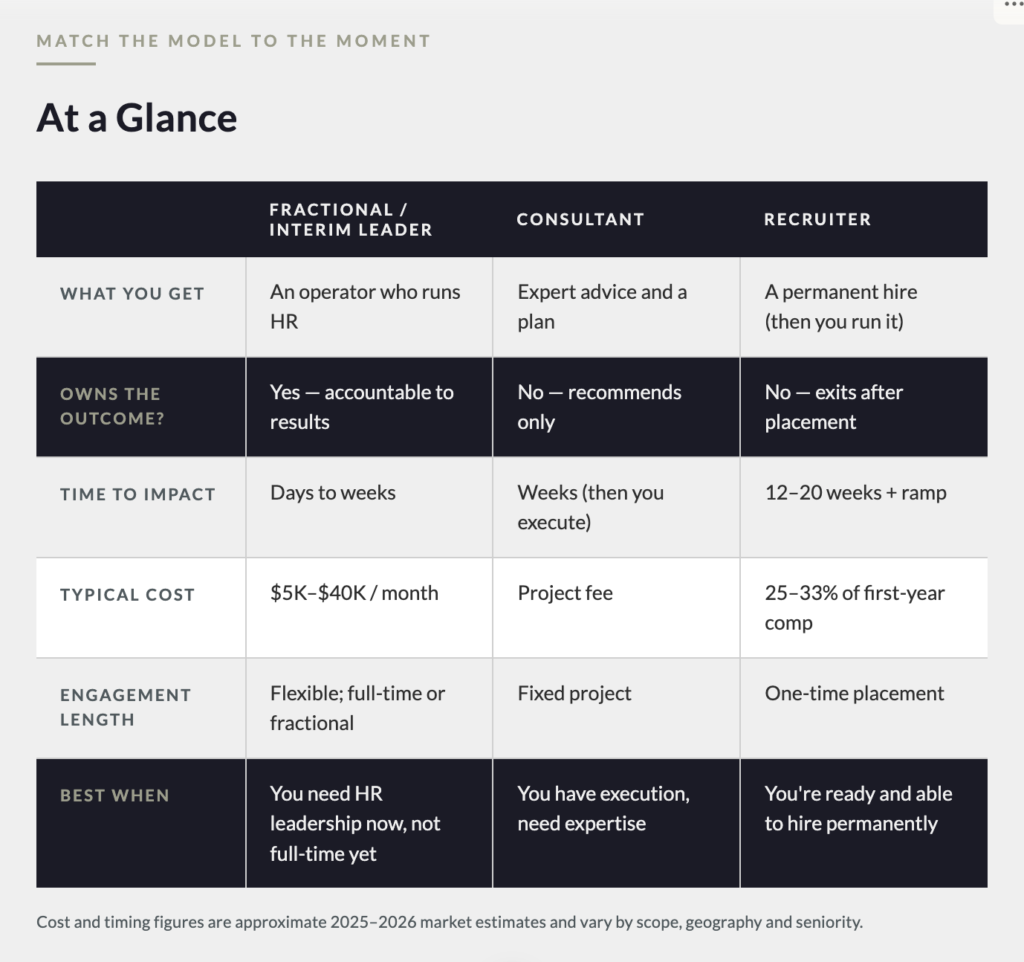
A consultant assesses, diagnoses and recommends. They’ll audit your HR function, identify gaps, design a strategy or operating model, and hand it to your team to execute. They’re not chairing your leadership team’s talent conversations, managing your HR staff, or owning your compliance calendar. Engagements are project-based — defined scope, defined end date.
Best for when:
You already have someone who can execute, and you need outside expertise on a specific question. Org design. A comp benchmarking study. A culture diagnostic. An HR functional assessment to help you understand what you actually need and where to invest. An HR tech evaluation. A workforce transformation roadmap. The expertise is the deliverable — not the execution.
The Executive Recruiter
A recruiter finds and places a full-time, permanent HR leader. You define the role; they source, screen, and present candidates; you hire and carry the salary. Retained searches for senior HR executives typically run 25–33% of first-year total cash compensation and take 12–20 weeks from briefing to placement — can be longer for specialized industries or niche roles.
Best for when:
You’re certain you need a permanent, full-time HR leader, you can sustain the full compensation, and your organization has the runway to wait out a multi-month search and ramp period.
The Fractional or Interim HR Leader
A fractional or interim HR leader is a senior HR executive who steps into your organization and takes operational ownership. They chair the leadership team’s people conversations. They manage your HR team. They build or rebuild the infrastructure. They own outcomes, not deliverables. Engagements can be full-time or part-time depending on what the organization needs — and here’s what most leaders discover quickly: the experience level these executives bring often means they can create significant impact with less than a full-time commitment depending on your business needs. Most engagements start within days, not months. Costs typically range from $5,000–$40,000 per month depending on scope, complexity and time commitment.
Best for when:
You need experienced HR leadership now. You’re not yet ready — or able — to commit to a permanent hire. You’re navigating a transition or a leadership gap. Or you need a trusted operator to build or stabilize the function while you determine what the right long-term solution looks like.
A Simple Way To Decide
Two questions. That’s it.
First: do you need someone to own and run HR, or do you need expert advice on a specific problem? If you need ownership — someone accountable for your people strategy, your team, your culture, your compliance — it’s between a fractional leader and a recruiter. If you need targeted expertise to solve a defined question or need to figure out what you need, a consultant may be the right answer, and a more cost-efficient one.
Second: does your business require a full-time HR executive today? This is a different question than it sounds. You don’t want to compromise the strategic advisor in the C-suite — that seat matters. Culture, talent, organizational health, workforce strategy: these are business-critical conversations, and they need a sophisticated voice at the table. But that voice doesn’t always need to be full-time. What your organization can’t afford is leaving those decisions to someone who isn’t equipped to make them. Your office manager isn’t providing business strategy around culture and talent. Neither is the HR coordinator who’s been holding things together. If the function is leaderless at the strategic level, the cost is real — it’s just spread across legal fees, turnover, misaligned hires, and missed opportunities rather than a salary line.
If your business genuinely requires a full-time permanent executive today, and you have the clarity on what that role needs to deliver, a retained search is the right call. If you need senior-level strategic leadership but aren’t certain a full-time hire is the right structure right now, a fractional or interim leader may deliver more value, faster, for significantly less total cost. This can be appropriate as organizations scale until they are ready to hire their first full time executive.
That last point is worth sitting with. The comparison isn’t just retainer cost versus fully burdened salary. A seasoned fractional or interim HR leader — someone who has built and run the function before — tends to make better decisions faster. Fewer costly legal and compliance missteps. Lower turnover because the talent strategy is actually sound. Higher retention because managers are being developed and culture is being tended to. More ROI from your existing team because someone is finally building scalable systems instead of fighting fires. The savings often go well beyond the line item on the P&L.
These paths aren’t mutually exclusive. The smartest sequence I see most often: bring in a fractional or interim HR leader to stabilize the function and build the foundational infrastructure. Prove out what “good” actually looks like in your specific organization. Then, when you’re ready to run a permanent search, you’ll do it with clarity — and find the right person, not just the available one out of desperation.
Either way, you’re not guessing anymore.
Double Clicking On This Combination Path: The Interim Bridge to Permanent Search
There’s a scenario I see more than any other, and it’s one most organizations don’t plan for. Your HR leader leaves — or you’ve decided they’re not the right fit for where the organization is going. You know you need to run a search. But a quality retained search takes 12–20 weeks, and that’s before the new leader ramps. You’re looking at six months or more before anyone is fully in the seat.
What happens to your team in the meantime? What happens to the priorities that were already in flight? What happens to the talent decisions that can’t wait? What happens to a problem situation that isn’t being addressed?
This is where an interim HR leader changes the equation.
Rather than launching a search while the function goes leaderless — or worse, while a placeholder tries to hold it together — you bring in a seasoned interim leader to bridge the gap. They step in immediately, stabilize the team, and keep the work moving. They assess what’s working and what isn’t. They surface the things the next permanent leader needs to know walking in the door. And when the time comes, they support the transition — so the person you searched for actually lands well, instead of inheriting a mess.
The interim engagement also protects the search itself. When there’s no pressure to fill the seat out of desperation, you find the right person — not just the available one. You don’t compromise on fit because the organization is bleeding. You take the time to get it right.
And when the permanent hire starts, the interim leader doesn’t just hand over a calendar. They transfer knowledge, context and relationships. They help orient the new leader to the culture, the team dynamics, the open items, the political terrain. The onboarding is structured, not improvised.
The result: a better search, a better hire, a stable and supported team, and a leader who can actually hit the ground running.
“The comparison isn’t just retainer cost versus fully burdened salary. A seasoned fractional or interim HR leader — someone who has built and run the function before — tends to make better decisions faster. Fewer costly legal and compliance missteps. Lower turnover because the talent strategy is actually sound. Higher retention because managers are being developed and culture is being tended to. More ROI from your existing team because someone is finally building scalable systems instead of fighting fires. The savings often go well beyond the line item on the P&L.”
– Jamie Jacobs
Where Gig Talent Fits
Gig Talent operates across all three paths — and at the intersection of them.
Our network of Gig Talent Certified Executive Entrepreneurs™ includes principal-level HR executives who step in as fractional or interim leaders, embedded consultants who solve discrete strategic problems, and a boutique executive search partner who places permanent talent through Amplify Executive Search™. We bring these capabilities together under a single transformation ecosystem, which means you don’t have to source three different firms and hope they talk to each other.
What we won’t do: create dependency. When an engagement with Gig Talent ends, your team owns the work and the increased capabilities. That’s by design.
If you’ve read this and concluded you need a focused HR diagnostic, an interim CHRO to lead through a transformation, a retained search for a permanent placement — or some combination of all three — that’s exactly the conversation we’re built to have.
If you’re navigating transformation, building organizational capability or need fractional or interim leadership we can help.
ABOUT THE AUTHOR
Jamie Jacobs is CEO of Gig Talent, built to deliver principal-evel expertise deployed with precision to accelerate performance, culture, and growth. Her work is grounded in a simple belief: fear is the greatest barrier to transformation and courage expressed through bolder decisions, faster iteration, and more honest leadership is a multiplier that unlocks capability, innovation, and momentum inside organizations.
Connect with Jamie: linkedin.com/in/jlatianojacobs