


The Three-Bucket Workforce Budget
By Jamie Jacobs & Julius Soriano
Every year, leaders open the budget and ask how many full-time employees they need. Roles are changing faster than headcount plans can keep up, and AI agents are about to take on part of the work. Locking in permanent FTEs for work that may look very different in 18 months is a risky bet.
At Gig Talent, an Executive Talent Agency, we see this tension in nearly every planning conversation this time of year. It is also one of the most solvable problems a leadership team has.
The budget question has changed
The better question now is "what is the right way to fund the capability we need?" Headcount follows from that answer.
Most budget conversations I join start with a list of open seats. Seats are a reasonable place to begin, but they describe positions, and a position is only one way to get work done. When a leader starts with the capability the strategy requires, the funding options widen quickly.
A new way to budget: three buckets
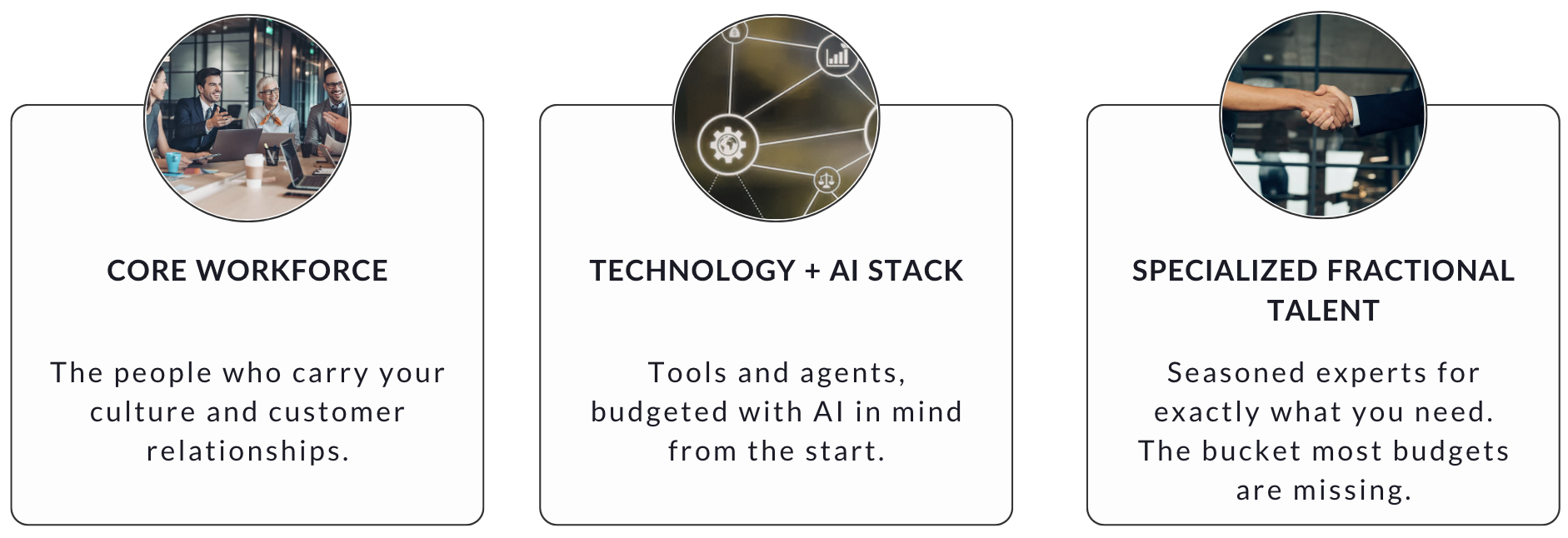
1. Core Workforce. Your essential employees: the people who carry your culture, your customer relationships, and the work that is central to your business. Keep investing here, and help these people grow into bigger, more capable roles.
2. Technology and AI Stack. Your tools, platforms, and agents, budgeted with AI in mind from the start. This is where repeatable work increasingly lives, and it needs to be planned for deliberately rather than added as an afterthought.
3. Specialized Fractional Talent. This is the bucket most budgets are missing. It holds specialized expertise from seasoned professionals who have lived the work before, brought in for exactly what you need them to do. Nobody is covering a gap until a permanent hire arrives. You may not need one full person. You may need several experts, each filling a different gap in your workforce and your technology stack.
Here is what that looks like in practice. Julius Soriano recently spoke with a head of HR who was new to her organization and beginning to evaluate her HR strategy and priorities for 2027 and beyond. As she assessed the current state of HR operations, she identified the need for additional expertise across several functional areas, including Compensation & Benefits, Talent Acquisition, and HRIS. Equally important, she wanted to ensure she was dedicating sufficient time to building relationships with senior leadership, advancing leadership development, and strengthening employee engagement.
Rather than immediately hiring full-time employees or building out an entirely new team, she took a more strategic and flexible approach. She identified the specific expertise and support needed across each functional area and began exploring opportunities to bring in experienced fractional experts who could quickly assess, address, and advance those priorities.
This approach allows her to access the right talent when and where it is needed, while also creating the time and space to evaluate the capabilities of her existing team. Ultimately, she can make more informed decisions about future organizational design, talent needs, and permanent hires based on a clearer understanding of the work, the gaps, and the strengths already within her organization.
Why the third bucket matters
- Right-sized capability. Pay for the expertise you need, not a full-time seat for a part-time need.
- Flexibility as work changes. As agents take on more tasks, you are not carrying permanent headcount for work that has shifted.
- Experience that has seen it before. Executives with 15 to 20 or more years in HR, finance, coaching, change management, and AI transformation work efficiently because they have done it.
- A complement to your team. Fractional experts strengthen your current team and make your technology investments work harder.
The three buckets also depend on each other. A strong core team gets more from the technology stack when an expert helps set it up well. An AI investment pays off sooner when someone who has led that kind of implementation before is working beside your people. Each bucket makes the other two more productive.
The Collective is Gig Talent's community of vetted and supported Certified Executive Entrepreneurs™ who step into fractional roles inside your organization. Through our Strategic Capability Partners, we also bring deep AI implementation and executive placement capability, and our trusted network connects you to the tools and specialists a project may need.
We work with you to map where the gaps are across your people and your tech stack, then match you with the right experts to fill them.
Start before the budget closes
Budget season is the moment to rethink the plan. Before FTEs are locked in for the year ahead, let us walk through your three buckets together and identify where specialized talent could do more for less risk. A plan that is still open can still change, and that is the best position a leader can be in.
Book a 30-minute budget conversation with Julius Soriano.